How to wire a light switch: one lamp, one switch and a breaker
One lamp switched from one place: what the breaker, the switch and each cable core do, why the switch must break the line and never the neutral, the wiring step by step, how to test it, and the mistake that leaves a lamp live when it is off.
Also in: Polski · Português (Brasil) · Deutsch

Transcript
One lamp, switched from one place. It's the first circuit every electrician wires, and its one rule matters in every circuit after it. This is the one-way switched lamp, an exercise in WireWhy's free course. The goal card says what has to work: the lamp on with the switch on, off with it off, and nothing tripping.
The supply gives us line, neutral and protective earth. A 16 amp breaker protects the circuit; the line goes through it first. The one-way switch has a common terminal, COM, and one switched terminal, L1. And the lamp, with line, neutral and earth.
The line from the supply into the breaker. Out of the breaker to the switch's common. From the switched terminal, L1, to the lamp's line. The lamp's neutral goes straight back to the supply's neutral: it never passes through the switch. And the protective earth to the lamp, so its metal parts are earthed.
Switch on, and the lamp lights. Switch off, and it goes dark. Check my work tests it the way the exercise sets it: switch on, switch off, and nothing tripping. All three pass.
The classic mistake: the switch in the neutral instead of the line. The lamp still goes on and off, so it looks right. But switched off, the lamp is still connected to the line: WireWhy marks it still live. Change the bulb, and you can touch a live part. Put it back: the switch breaks the line.
A switch interrupts the line, never the neutral, so a lamp that's off has no live parts. Try this exercise yourself, free and with no account, at wirewhy.com. The link is in the description.
A ceiling light, a switch by the door, and a breaker in the board. It is the first circuit every apprentice wires, and the simplest one in a house. It also carries one rule that matters in every circuit after it: the switch breaks the line, never the neutral. Get that wrong and the light still goes on and off, so nothing looks wrong, but the lamp holder stays live when the light is off.
This article walks through the circuit part by part, wires it step by step, and shows how to test it. You can wire the same circuit, risk-free, in the free exercise One-way switched lamp while you read.
Names first
The circuit is called one-way switching: one lamp (or a group of lamps) switched from one place. The switch is a one-way switch, in North America a single-pole switch. The conductor that runs from the switch to the lamp is the switched line (in the UK often the switch wire or switched live; the cable that carries it down to the switch is the switch drop).
What each part does
The breaker (MCB). The circuit starts at a miniature circuit breaker in the board, B16 in the exercise. It protects the cable: it trips on a short circuit, and on an overload that lasts too long. It does not protect people from a shock; that is the job of an RCD, which in many countries also covers lighting circuits in homes. The line conductor goes through the breaker first, so that everything after it, switch and lamp included, is switched off when it trips.
The switch. A one-way switch is a single contact, open or closed. In WireWhy it has two terminals: COM, the common, which takes the incoming line, and L1, the switched output. Real switches mark them in different ways (L and 1, COM and L1, or an arrow), and many modern switches are two-way switches that work as one-way switches when only two of their three terminals are used.
The lamp. A lamp, or the light fitting it sits in, has three terminals: L (line), N (neutral) and, for a class I fitting with metal parts, PE (protective earth). A class II fitting, double insulated and marked with a square inside a square, has no earth terminal.
The cable cores. Under the harmonised colours of IEC 60445, used across Europe and in the UK:
| Conductor | Colour | In this circuit |
|---|---|---|
| Line | brown (also black or grey) | supply to breaker, breaker to switch, switch to lamp |
| Neutral | blue | lamp back to the supply's neutral |
| Protective earth | green-and-yellow | the supply's earth to the lamp's PE terminal |
The switched line is a line conductor, so it belongs in a line colour. Green-and-yellow is used for nothing but earth.
Why the switch goes in the line, never the neutral
A lamp lights when current can flow from the line, through the lamp, back to the neutral. Breaking the circuit on either side stops that current, so a switch in the neutral turns the light off too. The difference is what stays connected.
With the switch in the line, a lamp that is off is disconnected from the line. Its holder, its terminals and the cable to it are connected only to the neutral, which sits close to earth potential.
With the switch in the neutral, the lamp that is off is still connected to the line. The holder's contact, the terminals and the wiring inside the fitting are all at full mains voltage to earth. Nothing flows, because the return path is open, but anyone who touches a live part while standing on the floor closes a different path, through their body to earth. That is exactly what happens when someone changes a bulb "with the light off". This is why the wiring rules in every country agree that a single-pole switch goes in the line conductor, and why a polarity test is part of checking a new installation.
Wiring it, step by step
This is the exercise's reference answer, in the order the video wires it:
- Supply L to the breaker's input. The line enters the protective device first.
- Breaker output to the switch's COM. The protected line goes down to the switch.
- Switch L1 to the lamp's L. This is the switched line.
- Lamp N straight back to the supply's N. The neutral never passes through the switch.
- Supply PE to the lamp's PE. The earth goes to the fitting so its metal parts are earthed. The exercise's goals do not check this wire, but a class I fitting needs it, so connect it anyway.
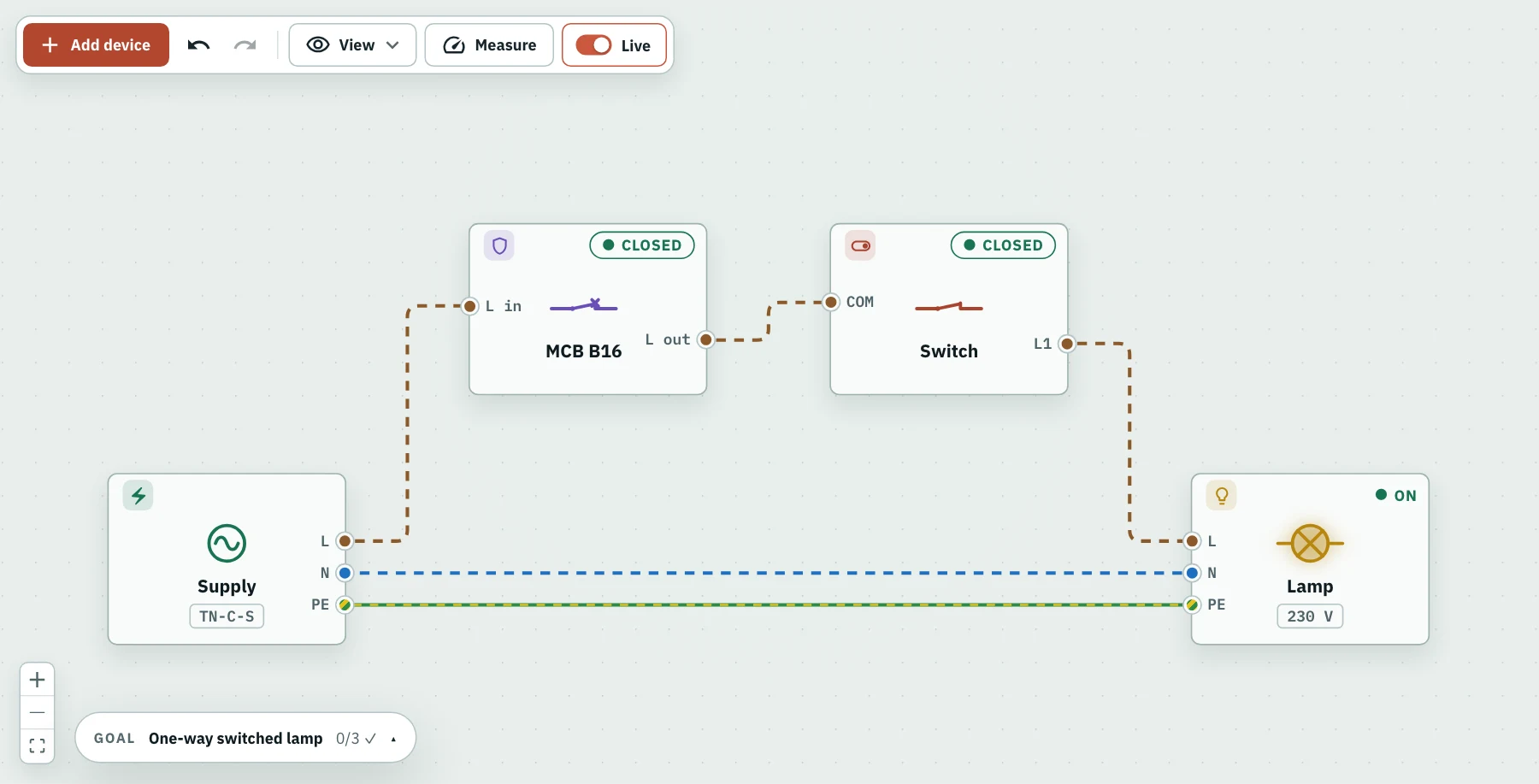
Wired as the exercise expects: the line goes through the breaker and the switch to the lamp, the neutral comes straight back, the earth goes to the lamp. With the switch on, the lamp lights, and the moving dashes show the current in the line and the neutral.
In a real house the conductors meet in a junction box or at the ceiling rose, not on one board, and the same five connections are made with cable and connectors. Where the fitting has an Edison screw holder, the centre contact takes the switched line and the screw shell takes the neutral: the shell is the part a finger can reach while screwing in a bulb.
Some countries add details of their own. In the UK, a switch drop is often run in twin-and-earth cable, whose blue core then carries the switched line; that core has to be sleeved or marked brown at both ends so that nobody takes it for a neutral. Smart and dimmer switches that need a neutral are another reason many electricians now take a neutral to the switch box, even when an ordinary switch does not use it.
Testing it
The quick test is functional: switch on, the lamp lights; switch off, it goes dark; the breaker holds. That is what the exercise's Check my work does: it sets the switch on, then off, and checks that nothing trips. All three goals pass with the circuit above.
A functional test does not find a switched neutral, though, because the lamp switches either way. Check my work does: with the switch in the neutral, the lamp-off goal fails, because the switched-off lamp is still live, and the canvas marks it Still live. On a real installation, that takes a polarity test: with the switch off, there should be no voltage between the lamp's line terminal and earth. On a new installation, an electrician also tests the earth's continuity to the fitting and the insulation resistance of the circuit before it is ever switched on. Our article on measuring an installation explains these tests and the readings to expect.
The classic mistakes
- The switch in the neutral. The lamp goes on and off, so it passes a functional test, but switched off it stays connected to the line. In WireWhy, wire it this way, switch off, and the lamp is marked Still live. Changing the bulb would mean touching a live part.
- No earth to a class I fitting. Everything works, which is why it gets missed. If the line ever touches the metal body, the fitting becomes live and nothing may trip until someone touches it. Connect the earth every time, even when the circuit works without it.
- The switch across line and neutral. If the switch is wired between L and N instead of in series with the lamp, switching on is a short circuit, and the breaker trips at once, in the simulator as on a real board.
- The neutral taken from somewhere else. A lamp whose neutral comes back on another circuit, or around an RCD rather than through it, works until the RCD notices the imbalance. Our article Why does my RCD trip? shows why.
- Wrong colours. A blue or green-and-yellow core used as the switched line may work, but the next person to open the box will trust the colour.
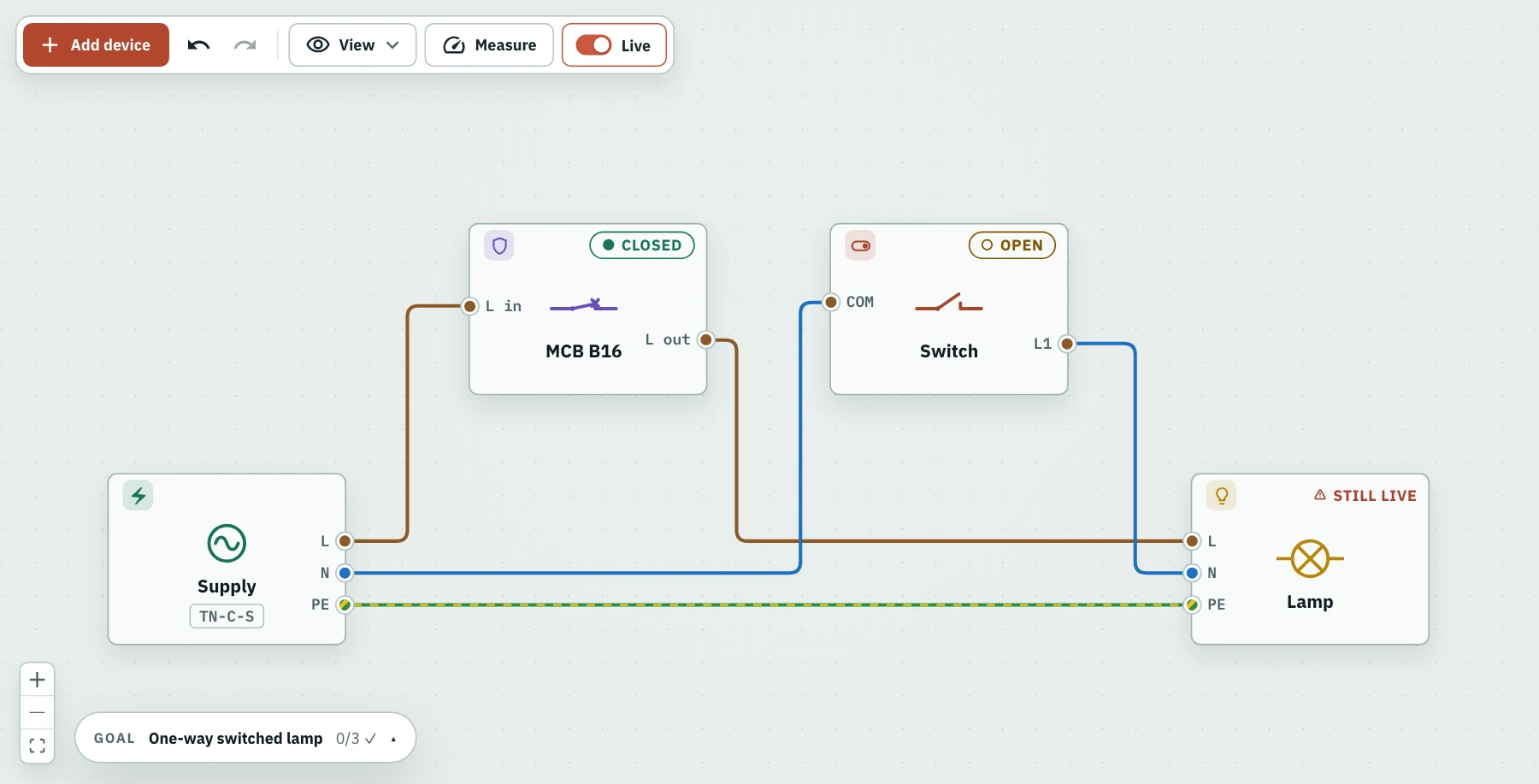
The classic mistake: the switch in the neutral. The switch is off and the lamp is dark, but it is still connected to the line, and WireWhy marks it Still live.
Safety: before you touch a real switch
Changing a light switch is the one electrical job many people try at home, and the rules on who may do it differ from country to country. Whoever does it, the work is done dead:
- switch off the circuit's breaker, and lock it off or keep the board closed so nobody switches it back on;
- prove your voltage tester on a known live source;
- test at the switch and at the lamp that there is no voltage between any of the conductors, including to earth;
- prove the tester again.
A light switch is a bad place to trust "off": in an older or altered installation, a switch box or a ceiling rose can hold conductors from more than one circuit, so test every conductor, not only the ones you expect. If anything you find does not match what you expected (more cores than there should be, no earth at the fitting, scorch marks, an old installation with rubber insulation), stop and call a qualified electrician.
Next steps
Once one switch makes sense, two switches for one light is the natural next puzzle: Two-way and intermediate switching explained builds on exactly this circuit.
Try it yourself
The One-way switched lamp exercise is the first build exercise in WireWhy's free course. Wire the supply, the B16 breaker, the switch and the lamp, click the switch, and press Check my work. Then move the switch into the neutral, switch it off, see which parts are still live, and press Check my work again.
Open the canvas at wirewhy.com/app: it is free and needs no account.
More from the same course: How to wire a socket outlet; Staircase timer wiring; Does a metal light fitting need earthing?.
Your turn
One-way switched lamp
Free, no account needed. It opens in the simulator.
Open the exercise →