Why does my RCD trip? How a residual current device works, and what the test button really checks
An RCD compares the current going out on the line with the current coming back on the neutral. Here is why it trips, the wiring mistakes that make it trip for no obvious reason, and what pressing TEST does and does not prove.
Also in: Polski · Português (Brasil) · Deutsch
The lights go out, the fridge stops humming, and in the board one switch has dropped: the RCD. You push it back up and it drops again, or it holds for a week and then trips in the middle of the night. To understand why, you only need one idea: an RCD does not measure how much current flows. It measures whether all of it comes back.
What an RCD is for
A residual current device (RCD, also RCCB; in German FI-Schutzschalter, in Polish wyłącznik różnicowoprądowy, in Brazil DR) protects people. It switches off when current leaks out of the circuit: through damaged insulation, through a wet appliance, or through a person.
What it does not do matters just as much:
- It does not protect the cable against overload or a short circuit between line and neutral. Every circuit behind an RCD still needs an MCB or a fuse. An RCBO combines both in one device.
- It does not protect someone who touches line and neutral at the same time. The current goes out on one and comes back on the other, so to the RCD it looks like a normal load.
- It does not limit how large a shock current is. It limits how long it lasts.
How it works: one ring, two conductors
Inside the RCD, the line and the neutral both pass through a small ring-shaped transformer core. In a healthy circuit, every ampere that goes out on the line comes back on the neutral. The two magnetic fields cancel and the ring sees nothing.
If some current returns another way, through the protective earth (PE), the ground, or a body, the two currents are no longer equal. The difference is called the residual current. It magnetises the ring, a small winding picks it up, and the release opens the contacts.
The device is rated by its rated residual current, IΔn:
| IΔn | Typical use |
|---|---|
| 10 mA | Single circuits where extra sensitivity is wanted, such as some bathroom equipment |
| 30 mA | Protection of people: socket circuits, bathrooms, outdoor circuits |
| 100 mA, 300 mA | Fire protection, and upstream devices for selectivity |
A 30 mA RCD must trip somewhere between half and all of its rating: between 15 mA and 30 mA. At 30 mA, a standard (non-delayed) RCD must open within 300 ms; at 150 mA (five times the rating) within 40 ms. That speed is the point. The value of 30 mA and those times are chosen so that the current through a body is switched off before it is likely to stop the heart.
Selective RCDs (type S, marked with an S in a square) deliberately wait a little longer. They go at the origin of an installation, so that a 30 mA RCD further down opens first and only the faulty circuit goes dark.
Where RCDs are required
IEC 60364-4-41 asks for additional protection by a 30 mA RCD for socket outlets up to 32 A used by ordinary people, and IEC 60364-7-701 for all circuits in rooms with a bath or shower. National rules build on this:
- UK (BS 7671): 30 mA protection for sockets up to 32 A, for cables buried in walls at shallow depth, and for lighting circuits in homes.
- Germany (VDE 0100-410): 30 mA RCDs for sockets up to 32 A and for final circuits supplying lighting in dwellings.
- Poland (PN-HD 60364): follows the IEC text; in practice new homes put nearly every circuit behind a 30 mA RCD.
- Brazil (NBR 5410): a DR of 30 mA or less for bathrooms, kitchens, laundry and service areas, garages, outdoor areas, and sockets that may feed outdoor equipment.
The type matters too. Type AC reacts only to smooth sinusoidal leakage. Type A also detects the pulsating DC that many modern appliances produce, and it is the usual minimum in new installations; some countries, Germany among them, no longer accept type AC.
Why it trips: the four usual causes
1. A real earth leakage
This is the RCD doing its job. A kettle with a cracked element, a washing machine heater, an outdoor socket full of rainwater, a nail through a cable. If it trips every time one particular appliance is switched on, unplug that appliance and have it checked.
2. A borrowed neutral
The most common wiring mistake behind "it trips as soon as I switch the light on". A circuit takes its line from behind the RCD but its neutral from somewhere else: another RCD, or the neutral bar before the RCD. The lamp's current leaves through the RCD's line and returns outside its ring. To the RCD, that is residual current, and it trips the moment the load draws current.
The fix is never a bigger RCD. Every circuit's neutral must come from the same RCD as its line.
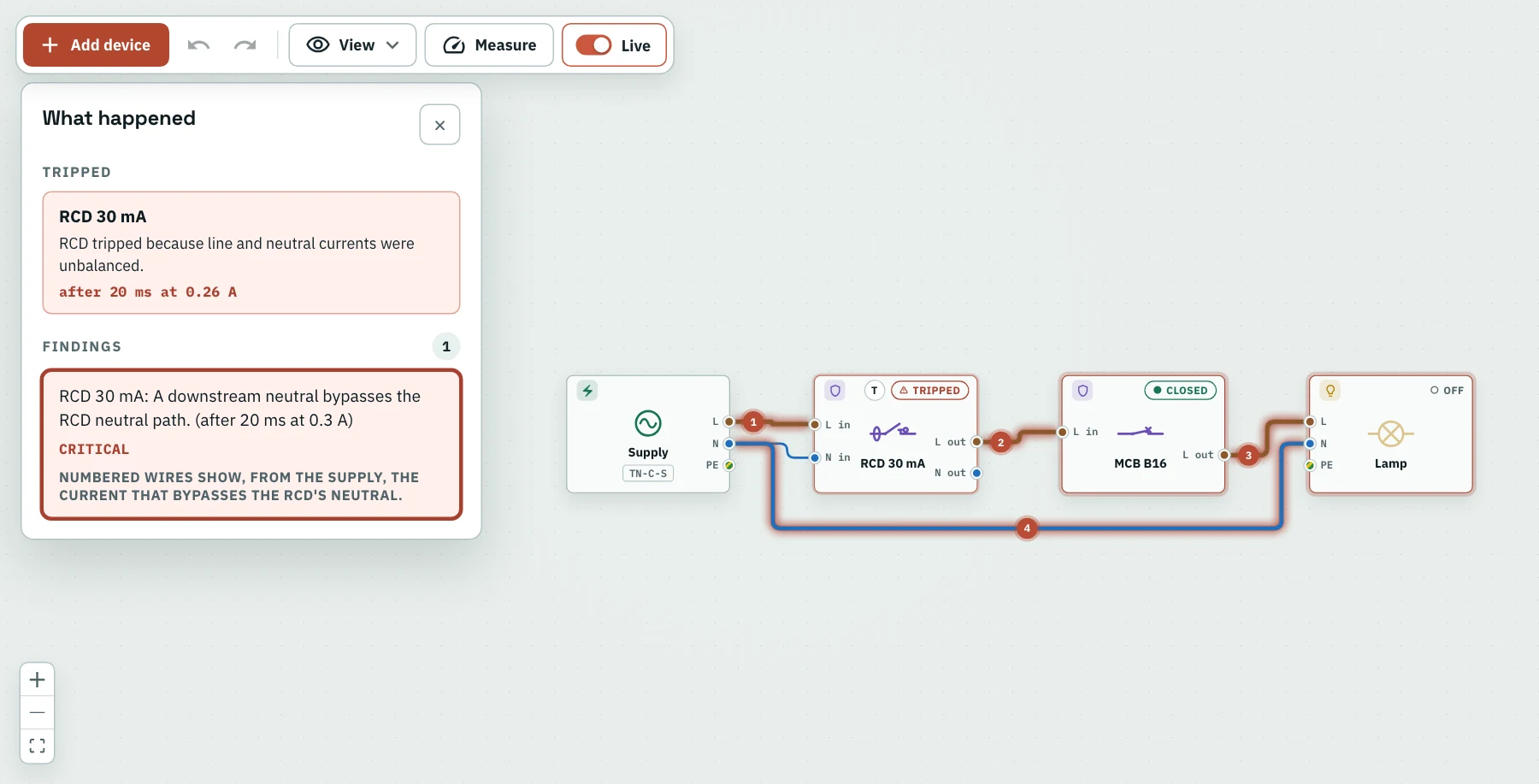
The lamp's line goes through the RCD, but its neutral comes straight from the supply. The RCD trips as soon as the lamp draws current; the numbered wires show the path of the current that bypassed it.
3. Neutral and earth joined after the RCD
If N and PE touch anywhere downstream of the RCD (a swapped conductor in a socket, a neutral screw touching a metal box, damp in a junction box), part of the neutral current returns through PE instead. The RCD sees the difference and trips, often only when the load is on, which makes it look random.
4. Leakage that adds up
Computers, chargers, LED drivers, and appliances with mains filters all leak a little current to PE by design. Each is harmless; twenty of them on one 30 mA RCD may not be. A common rule of thumb is to keep the standing leakage below about 30 % of IΔn, which is one reason to split an installation across several RCDs, or to give each circuit an RCBO.
What the test button does
The TEST button connects a resistor from the line on one side of the ring to the neutral on the other side. The test current goes out through the ring but comes back around it, so the RCD sees a deliberate residual current and should trip.
Pressing it proves that the ring, the release, and the mechanism work, and it keeps the contacts from sticking. Manufacturers recommend it every few months; the label on the device says how often.
What it does not prove:
- that the RCD trips fast enough at its rated current (that is measured with an RCD tester);
- that the installation's earthing works, because the test current never goes through PE;
- that every circuit you think is protected really goes through this RCD.
If it does not trip when you press TEST, the RCD is faulty. Leave it switched off and call an electrician.
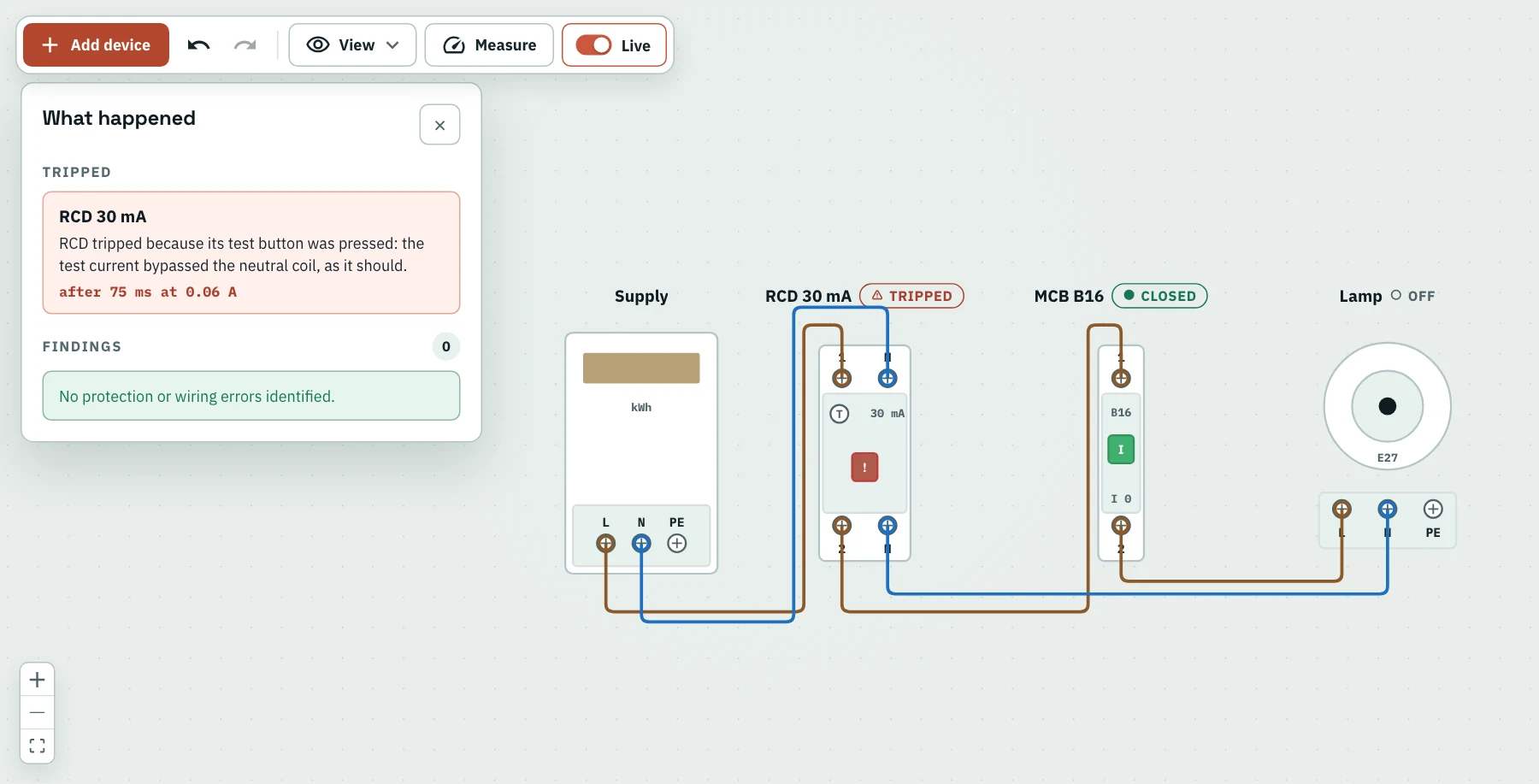
The same circuit wired correctly, in the realistic view, after pressing TEST: the RCD trips and no wiring error is found. The test proves the mechanism, not the earthing.
When to call an electrician
Resetting an RCD after a one-off trip is fine. Repeated tripping is a message: something leaks, or something is wired wrong. Finding it means isolating circuits, measuring insulation resistance, and opening accessories, which is work for a qualified electrician. Never bridge an RCD or swap it for a less sensitive one to "fix" tripping.
See it happen, safely
Every cause above can be built and broken in WireWhy without any risk. Wire a supply, a 30 mA RCD, an MCB, and a lamp, then take the lamp's neutral from the supply instead of from the RCD: the RCD trips when the lamp comes on, and WireWhy numbers the wires the unbalanced current took. Swap N and PE on a socket, put an earth fault on a heater, or press the RCD's test button and read what happened and why.
Open the canvas at wirewhy.com/app and try it: it is free and needs no account.