Two-way and intermediate switching explained: one light, two or more switches
How a staircase light can be switched from the top and the bottom: what is inside a two-way switch, how the travellers work, where an intermediate switch goes, and the wiring mistakes that make it work only sometimes.
Also in: Polski · Português (Brasil) · Deutsch
A light at the top of the stairs, a switch at the bottom and another at the top, and either one turns it on or off, whatever the other one is doing. It feels like a small puzzle, and it is one of the first circuits every apprentice wires. Once you see what is inside the switch, it is simple.
Names first
The same circuit has different names depending on where you learned it:
| Where | Two switches | Three or more |
|---|---|---|
| UK and IEC | Two-way switch | Intermediate switch |
| North America | 3-way switch | 4-way switch |
| Poland | Łącznik schodowy | Łącznik krzyżowy |
| Germany | Wechselschalter | Kreuzschalter |
| Brazil | Interruptor paralelo | Interruptor intermediário |
The two wires that run between the switches are the travellers (strappers in some parts of the UK).
What is inside a two-way switch
A one-way switch has two terminals and a contact that is either open or closed. A two-way switch has three terminals and a changeover contact:
- COM (common, often marked L, C, or with a different coloured screw) is always connected to something.
- L1 and L2 are the two outputs. The common is connected to one of them or the other. Each press moves it across.
There is no "off" position. The switch only chooses which traveller the common is connected to.
How two of them control one light
Wire them like this:
- The line from the circuit's MCB goes to COM of the first switch.
- L1 of the first switch goes to L1 of the second, and L2 to L2. These are the travellers.
- COM of the second switch goes to the lamp. This is the switched line.
- The lamp's other terminal goes to the neutral, and its PE terminal (for a class I luminaire) to the protective conductor.
Now follow the current. The lamp lights only when both commons point at the same traveller: both on L1, or both on L2. If they point at different travellers, the path is open.
| Switch 1 | Switch 2 | Lamp |
|---|---|---|
| L1 | L1 | On |
| L1 | L2 | Off |
| L2 | L1 | Off |
| L2 | L2 | On |
Pressing either switch changes which traveller its common uses, so it always changes the result. That is the whole trick.
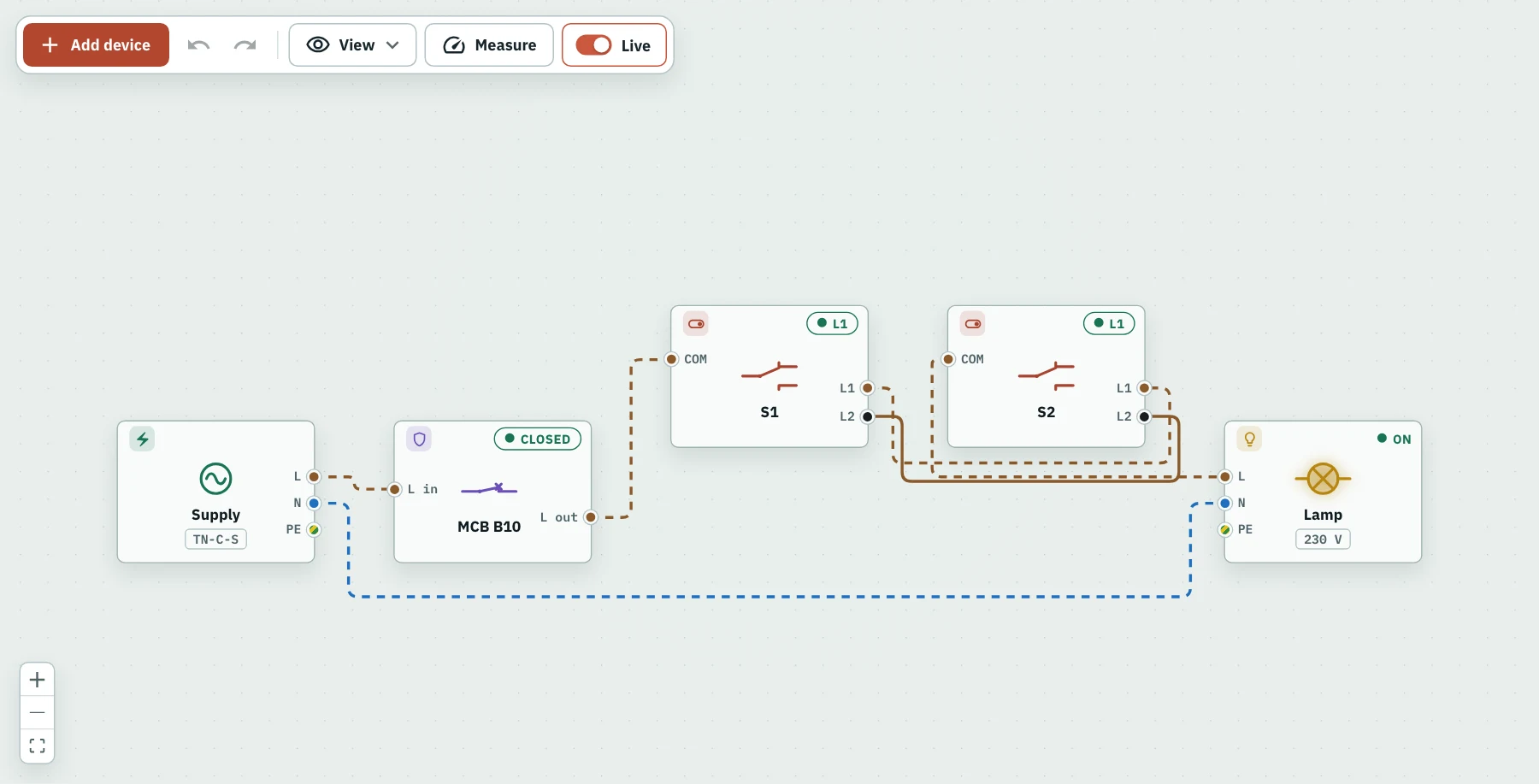
Both commons on L1: the path through the travellers is closed and the lamp is on. Click either switch and it goes out.
Adding a third place: the intermediate switch
For a long corridor or a staircase with three floors, you add an intermediate switch in the travellers, between the two two-way switches. It has four terminals: two inputs and two outputs.
- In one position it passes the travellers straight through: in 1 to out 1, in 2 to out 2.
- In the other it crosses them: in 1 to out 2, in 2 to out 1.
Crossing the travellers swaps which one is live, so pressing the intermediate switch always changes the light, whatever the others do. You can add as many intermediate switches as you like, one after another in the travellers. The circuit always starts and ends with a two-way switch.
The usual mistake is mixing up the pairs: one traveller from the first switch lands on an input and the other on an output. The light then works in some combinations and not in others. Makers mark the pairs differently (arrows, 1 and 2 on each side, or a diagram on the back), so read the switch before wiring it.
For more than three or four places, most electricians switch to push-buttons and an impulse relay (a latching relay: each press toggles it), or a staircase timer that switches the light off by itself.
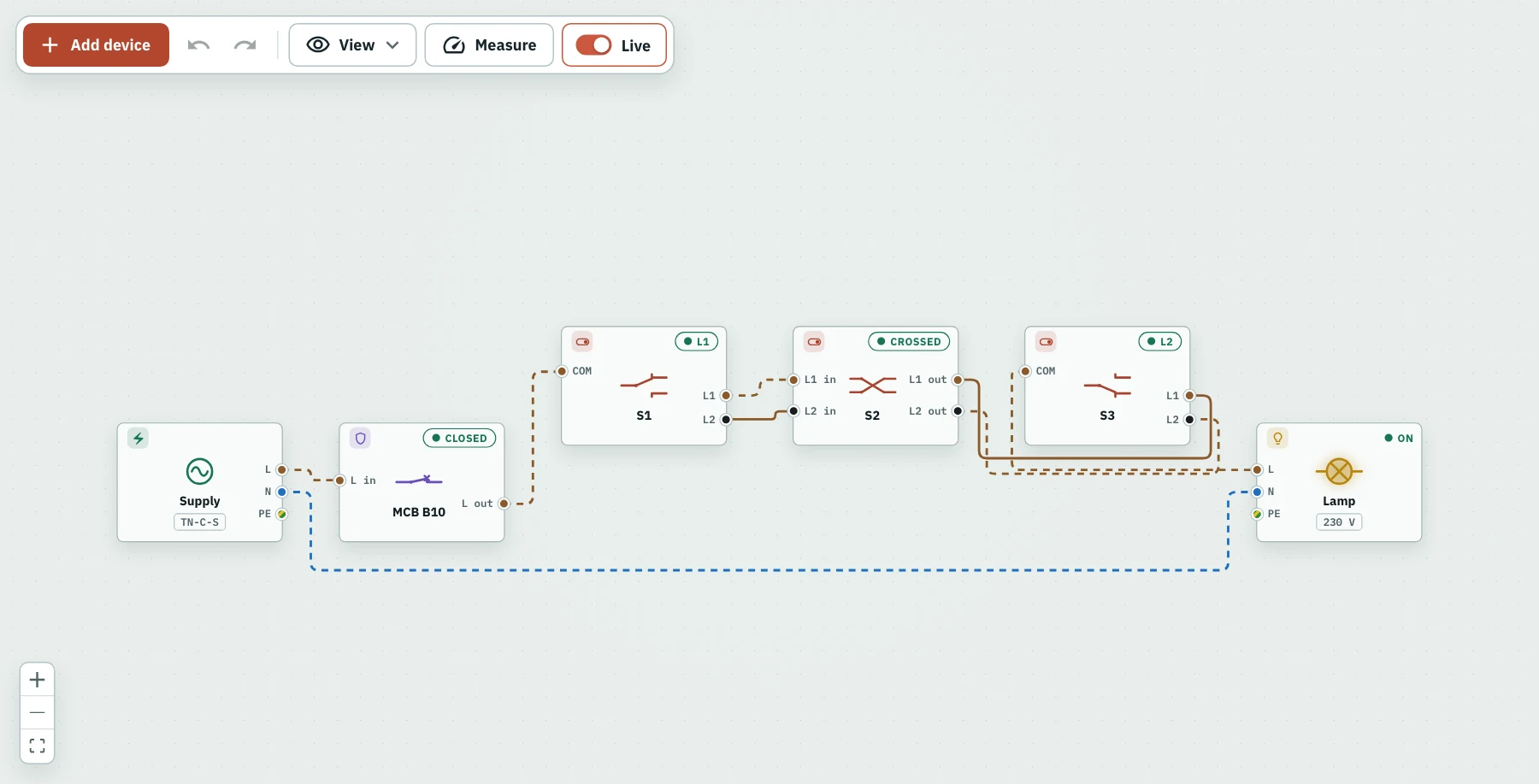
An intermediate switch between the two two-way switches. S2 crosses the travellers, so with S1 on L1 and S3 on L2 the lamp is still on.
Colours and conductors
The travellers carry line voltage when they are live, so they must be in line colours. Under IEC 60445:
- line: brown, black, or grey;
- neutral: blue;
- protective earth: green-and-yellow, used for nothing else.
A traveller in blue or green-and-yellow is a real hazard: the next person to open the box will assume it is a neutral or an earth. National practice adds its own details:
- UK (BS 7671): travellers usually run in three-core-and-earth cable with brown, black, and grey cores. If a blue core has to be used as a line conductor, it must be sleeved or marked brown at both ends.
- Germany: typically NYM-J 3×1.5 or 5×1.5 cable; the travellers are called korrespondierende Leiter.
- Poland: travellers are przewody korespondencyjne; in the Polish switch numbering, the two-way switch is type 6 and the intermediate type 7.
- Brazil (NBR 5410): neutral is light blue and PE green-and-yellow or green; the switched wire to the lamp is called the retorno.
The mistakes that make it "work sometimes"
The simulator's findings for this circuit are the same ones an instructor checks for:
- A traveller swapped with the common. The light works in only some combinations of switch positions. This is the classic one.
- Switching the neutral instead of the line. The light goes out, but the lamp holder stays live. Anyone changing a bulb with the switch off can still get a shock. Switches always interrupt the line.
- A neutral landed on a traveller terminal. In some switch positions the switch then joins line and neutral directly: a short circuit that trips the MCB.
- Blue or green-and-yellow as a traveller. It may work, but it is wrong, and dangerous for whoever comes next.
A note on real installations
Swapping a switch in your own home is legal in some countries and not in others, and it always means working on the circuit with it isolated, locked off, and proven dead. If you are not trained to do that, ask a qualified electrician. Learning the circuit is a different thing, and you can do it without any risk.
Build it yourself
In WireWhy you can place a supply, an MCB, two two-way switches, an intermediate switch, and a lamp, wire them, and click the switches to see the lamp respond, with the current shown on every wire. Then swap a traveller with the common and watch which combinations stop working, or move the switch into the neutral and read what WireWhy finds.
Open the canvas at wirewhy.com/app and wire your first two-way circuit. For the protection side of the same board, read Why does my RCD trip?