Does a metal light fitting need earthing? Why, and how to connect it
A metal light fitting can work perfectly and still be dangerous. Class I or class II, what the protective earth does when a wire touches the case, how to connect it, how it is tested, and what to do when the ceiling has no earth at all.
Also in: Polski · Português (Brasil) · Deutsch

Transcript
This metal light fitting works: switch on, and it lights. So is the job done? This is the earthing exercise in WireWhy's free course. The goal adds one more test: touching the metal case must be safe even when the line touches it.
Try it puts that fault on the fitting: the line touching its metal case, as a chafed wire or a loose terminal would. The case is now at 230 volts, and nothing trips. The breaker sees no fault current, because there is no path for it, until someone touches the case and becomes that path.
The fitting has a PE terminal for its metal case, and nothing is connected to it. Connect it to the supply's protective earth.
The same fault again. Now the current has a path back through the protective earth: hundreds of amps, and the breaker disconnects in milliseconds. The case is no longer live. Reset the breaker, and Check my work: the lamp lights, the case is safe, nothing trips.
A metal fitting must have its protective earth connected. Then a fault to the case makes the breaker disconnect, instead of leaving the metal live.
Try this exercise yourself, free and with no account, at wirewhy.com. The link is in the description.
A metal light fitting hangs over a workshop bench. Whoever fitted it connected the line and the neutral, switched on, saw the lamp light, and went home. The switch works and nothing trips. Is the job done?
Not yet. A light that works only proves that line and neutral reach the lamp. It says nothing about what happens on the day a wire inside the fitting chafes through or a terminal works loose and touches the metal body. Whether that day ends with a tripped breaker or with someone getting a shock depends on one green-and-yellow conductor: the protective earth, PE.
This article explains why a metal fitting needs it, what it does in a fault, how it is connected and tested, and what to do when the ceiling has no earth to connect to. It is not a how-to for working on your own wiring: in most countries, work on fixed wiring is for a qualified electrician. If you want to see the fault without any risk, the free exercise Earthing a metal light fitting puts it on a fitting in your browser and lets you fix it.
Class I or class II: read the label first
Light fittings, like all electrical equipment, are built to a protection class, and the class tells you whether the earth is needed.
- Class I fittings rely on two things: basic insulation around the live parts, and an earthed metal body. If the insulation fails, the earth is what makes the fault safe. A class I fitting has a terminal for the protective conductor, marked with the earth symbol (a vertical line over three horizontal lines, shortest at the bottom), often screwed straight to the metal chassis. Most metal fittings are class I.
- Class II fittings have double or reinforced insulation, so no single failure can make an accessible part live. They are marked with a square inside a square and have no earth terminal. They do not need a PE, and nothing should be connected to them as one.
- Class III fittings (a diamond around a Roman III) run on safety extra-low voltage and need no earth either.
So the question is not really "metal or plastic" but "is there an earth symbol on the terminal block". If there is, the PE must be connected.
What happens in a fault without the earth
Picture the fitting wired as above: line through the switch to the lamp, neutral back, PE terminal empty. Now the line conductor inside touches the metal body.
The lamp keeps working. The breaker does not trip, because no extra current flows: the line has touched a piece of metal that leads nowhere. The body is now at line voltage, 230 V in most of the world, and nothing tells you anything is wrong.
The fault only becomes a current when someone touches the fitting while standing on the floor, leaning on a bench or holding a metal ladder. Then their body is the path to earth. A current of tens of milliamps through the body is enough to cause muscle cramp and, from the hand across the chest, a risk of heart fibrillation; with a damp floor or bare skin it can be more. A 16 A breaker cannot react to that: it is built to protect cables from currents a thousand times larger.
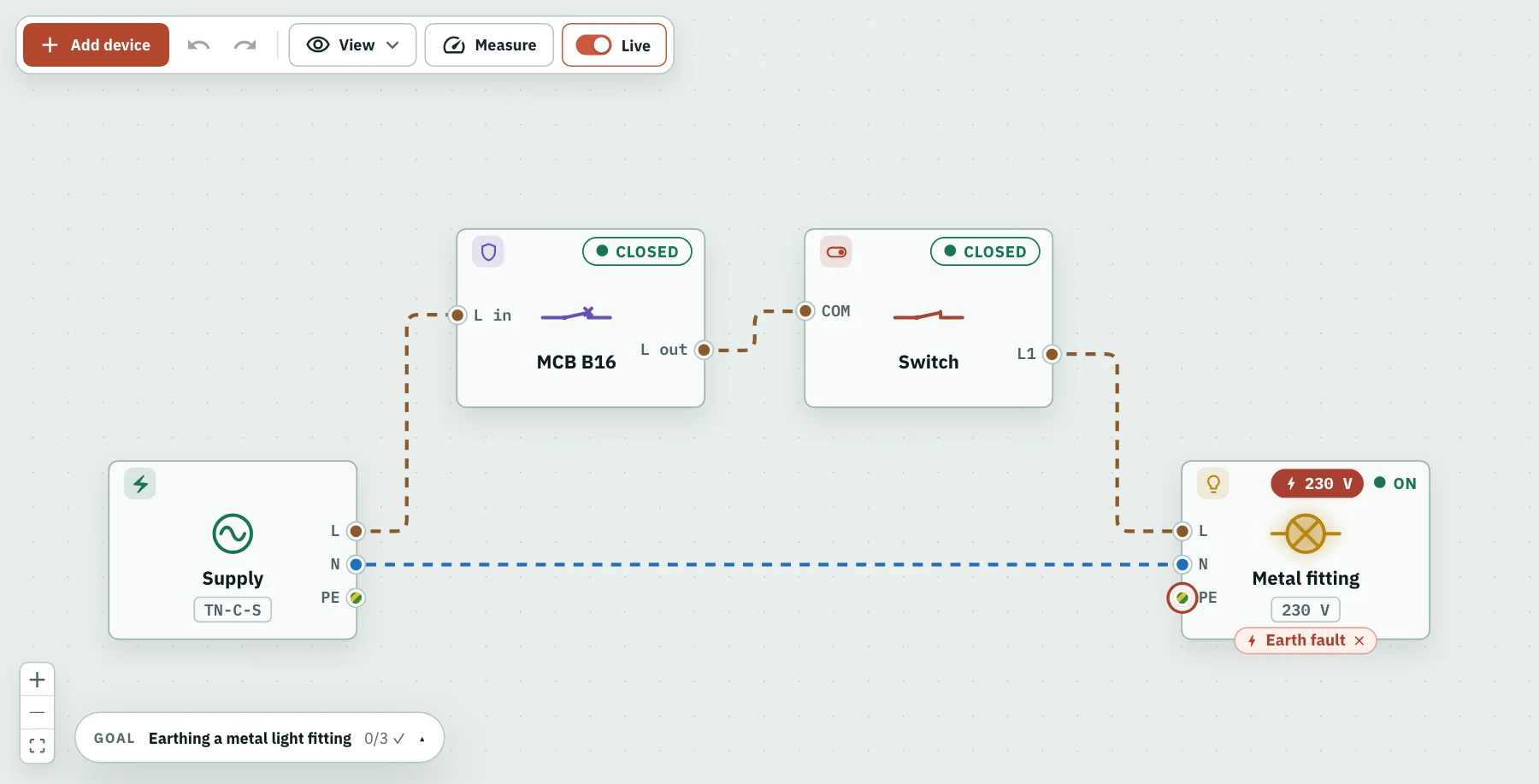
Without the PE: the line touches the fitting's metal case. The lamp still lights, the B16 stays on, and WireWhy shows the case at 230 V: a shock waiting for someone to touch it.
What the protective earth does
Connect the fitting's PE terminal to the circuit's protective conductor, and the same fault behaves completely differently. The metal body now has a low-resistance metallic path back to the source: along the PE to the board's earth bar, and in a TN system along the supplier's PE or PEN back to the transformer. When the line touches the body, current flows round that loop: line, fault, PE, back to the source.
The loop is made of copper, so the current is large, often hundreds of amperes. A B16 breaker's magnetic release trips within milliseconds once the current is above five times its rating, 80 A. The fault is disconnected before anyone has a chance to touch the fitting, and the case is never left live. For final circuits up to 32 A in a TN system, IEC 60364-4-41 asks for disconnection within 0.4 s at 230 V; a correctly earthed lighting circuit trips much faster than that.
This is called automatic disconnection of supply: the earth does not make the metal safe on its own, it gives the fault current a path big enough for the protective device to switch the circuit off.
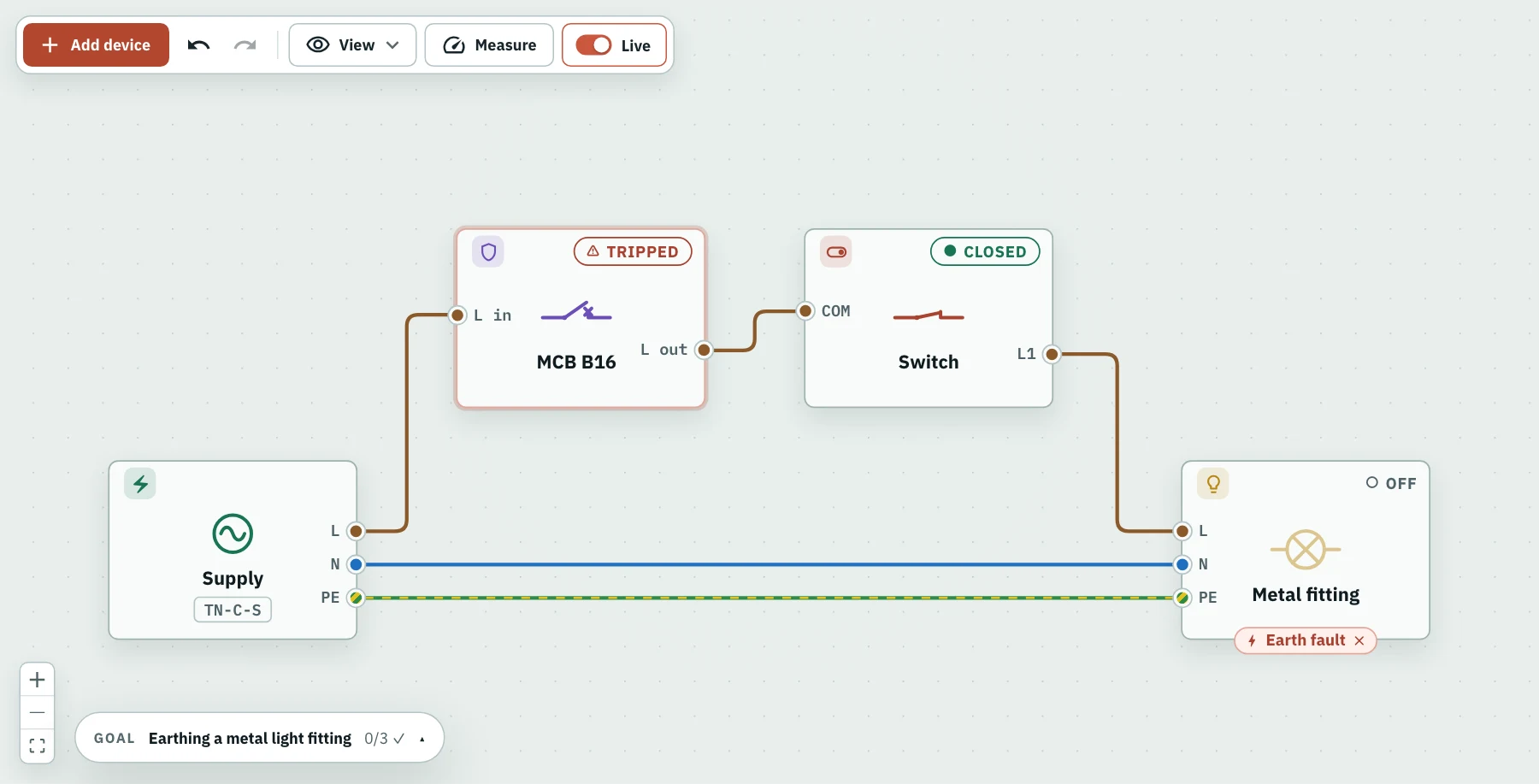
With the PE connected: the same fault. The current returns through the protective earth, hundreds of amperes, and the B16 disconnects the circuit in milliseconds.
Where the RCD fits in
In a TT installation, where the house has its own earth electrode, the fault current has to return through the soil and is only a few amperes, too small to trip the breaker. There, a 30 mA RCD does the disconnecting, and it still needs the PE: without it, the RCD sees nothing until a person provides the path. The details are in TN-C-S, TN-S and TT earthing systems explained simply.
In TN installations, a 30 mA RCD is additional protection: it will disconnect even if the earth fails and someone touches a live case, because the current through them is a residual current. Many countries now require it on lighting circuits in homes. It is a second layer, not a replacement for the PE: it acts only once the current is already flowing through a body, and it limits how long the shock lasts, not whether it happens. How the RCD decides is explained in Why does my RCD trip?
Connecting the earth, step by step
This is how the exercise's answer is wired, and how a class I fitting is connected in a ceiling box with a three-core cable:
- Isolate and prove dead. Switch off the circuit's breaker, lock or label it, and prove there is no voltage at the ceiling with a two-pole voltage tester, checked on a known live source before and after. A switched-off light switch is not isolation: it only breaks the line to the lamp, and in a badly wired circuit it may break the neutral instead.
- Identify the three conductors. Switched line (brown, or a marked core), neutral (blue), protective earth (green-and-yellow).
- Line and neutral to the fitting's L and N terminals, as before.
- PE to the terminal with the earth symbol. The green-and-yellow conductor of the cable goes to the fitting's PE terminal, and nowhere else. Where the box has a PE connector for the cables passing through, the fitting's PE joins them there.
- Leave the PE a little longer than L and N, so that if the cable is ever pulled, the earth is the last to come out.
- Check the fitting's own earth path. Some fittings have separate metal parts (a canopy, a reflector) joined to the body by a short green-and-yellow lead; make sure it is in place and tight.
- Close up, restore, test.
In WireWhy, the same fix is one wire: from the supply's PE terminal to the lamp's PE terminal.
Testing the earth
An earth that looks connected is not proof. The electrician tests it, in two stages:
- Dead: continuity of the protective conductor. With the circuit isolated, a low-resistance ohmmeter (an installation tester sends a test current of at least 200 mA) measures from the board's earth bar, or from the circuit's line conductor linked to the PE at the board, to the metal body of the fitting. The result should be a fraction of an ohm, and consistent with the cable's length and size.
- Live: earth fault loop impedance and RCD. With the circuit back on, a loop tester measures the impedance of exactly the path the fault current would take, and checks that it is low enough for the breaker to disconnect in time. An RCD on the circuit is tested with an RCD tester.
The measuring side is covered in Measuring an electrical installation.
When the ceiling box has no earth
Older installations in many countries brought only two conductors to the lighting points: line and neutral. Putting up a new metal light there raises a real problem, and there are wrong and right answers to it.
Never connect the PE terminal to the neutral. It looks like a clever fix and is one of the most dangerous. If the neutral comes loose anywhere upstream, the current through the lamp now lifts the neutral, and the metal body with it, to line voltage. If the line and neutral are ever swapped (at the switch, in the box, by the next person), the body is directly live. And on a circuit with an RCD, current flowing back through the earthed metal instead of the neutral can cause unexplained tripping.
What to do instead:
- Choose a class II fitting (double square), which does not need an earth.
- Have a protective conductor run to the point. An electrician can often add one, or replace the cable.
- Add a 30 mA RCD to the circuit as additional protection, especially where the old wiring stays. It reduces the risk; it does not turn a class I fitting without an earth into a safe one.
- Call an electrician to look at the circuit before hanging a class I fitting on it. A metal fitting with an empty PE terminal is exactly the fitting from the exercise.
Classic mistakes
- PE left unconnected, as in the exercise. The light works, so nobody notices, until a fault.
- PE connected to the neutral in the box or in the fitting, discussed above.
- An earth lead inside the fitting missing or loose, so the terminal is earthed but the reflector or canopy is not.
- A green-and-yellow conductor used as a line or switched line, which makes every later reading wrong and is never allowed.
Try it in WireWhy
The free exercise Earthing a metal light fitting opens exactly this circuit: a supply, a B16 breaker, a switch, and a metal fitting that lights. Press Try it on the goal "Touching the metal case is safe when line touches it": WireWhy puts the line on the case, shows the touch voltage, and nothing trips. Connect the PE and try again: the breaker disconnects at once. Click the fault's marker on the fitting to take it off, switch the breaker back on, and press Check my work. Afterwards, build the same circuit on a blank canvas, set the supply's earthing system to TT, and see why the RCD matters there.
Open the canvas at wirewhy.com/app: it is free and needs no account.
More from the same course: How to wire a light switch; How to wire a socket outlet; Staircase timer wiring.
Your turn
Earthing a metal light fitting
Free, no account needed. It opens in the simulator.
Open the exercise →