TN-C-S, TN-S and TT earthing systems explained simply
Where does the current of an earth fault go, and what makes a breaker trip in time? The earthing system decides. The letters decoded, what each system does in a fault, a broken PEN, and why TT installations depend on RCDs.
Also in: Polski · Português (Brasil) · Deutsch
Two houses can have the same board, the same breakers, and the same cables, and still behave completely differently when a heater develops an earth fault. In one, the breaker trips in a few milliseconds. In the other, it never trips at all, and the heater's metal casing sits at about 200 V until an RCD switches it off. The difference is the earthing system: how the installation's protective earth is connected back to the source.
The letters
IEC 60364 names earthing systems with two or three letters.
- First letter, the source: T (from French terre, earth) means the transformer's star point is connected directly to earth. I means it is isolated from earth, or earthed through a high impedance.
- Second letter, the installation's exposed metal parts: T means they are connected to a local earth electrode of their own. N means they are connected to the source's earthed neutral point by a conductor.
- After a hyphen, for TN only: S means neutral (N) and protective earth (PE) are separate conductors; C means they are combined in one conductor, the PEN.
So TN-C-S reads: source earthed, exposed parts connected to the source's neutral point, with N and PE combined in one part of the system and separate in the rest.
TN-S: a separate earth all the way
The supplier runs a separate protective conductor from the transformer to the installation, often the metal sheath of the service cable. N and PE are separate everywhere.
In an earth fault, the fault current flows from the line, through the fault, and back to the transformer along a metal conductor. The loop impedance is small, the current is large (often hundreds of amperes), and the breaker's magnetic release trips it almost instantly.
TN-C-S: combined outside, split at the origin
The most common system in new supplies in much of Europe. The supplier brings a combined PEN conductor, and at the installation's origin (the service head or main earthing terminal) it is split into N and PE. From there on, they must never be joined again. The UK calls this PME (protective multiple earthing), because the supplier also earths the PEN at several points along the network.
An earth fault behaves as in TN-S: a metallic loop, a large current, a fast trip.
The weak point is the PEN itself. If it breaks between the transformer and the installation, the neutral current has no way back except through the installation's earthing. Loads push the whole PE system towards line voltage through their own impedance: the lamps go dim or dark, and every earthed metal part in the house (and anything bonded to it) can become dangerous to touch. An RCD does not necessarily see this, because the line and neutral currents through it are still equal. Suppliers reduce the risk by earthing the PEN repeatedly, and some uses (EV chargers, caravans, outdoor equipment in the UK, for example) have special rules for exactly this reason.
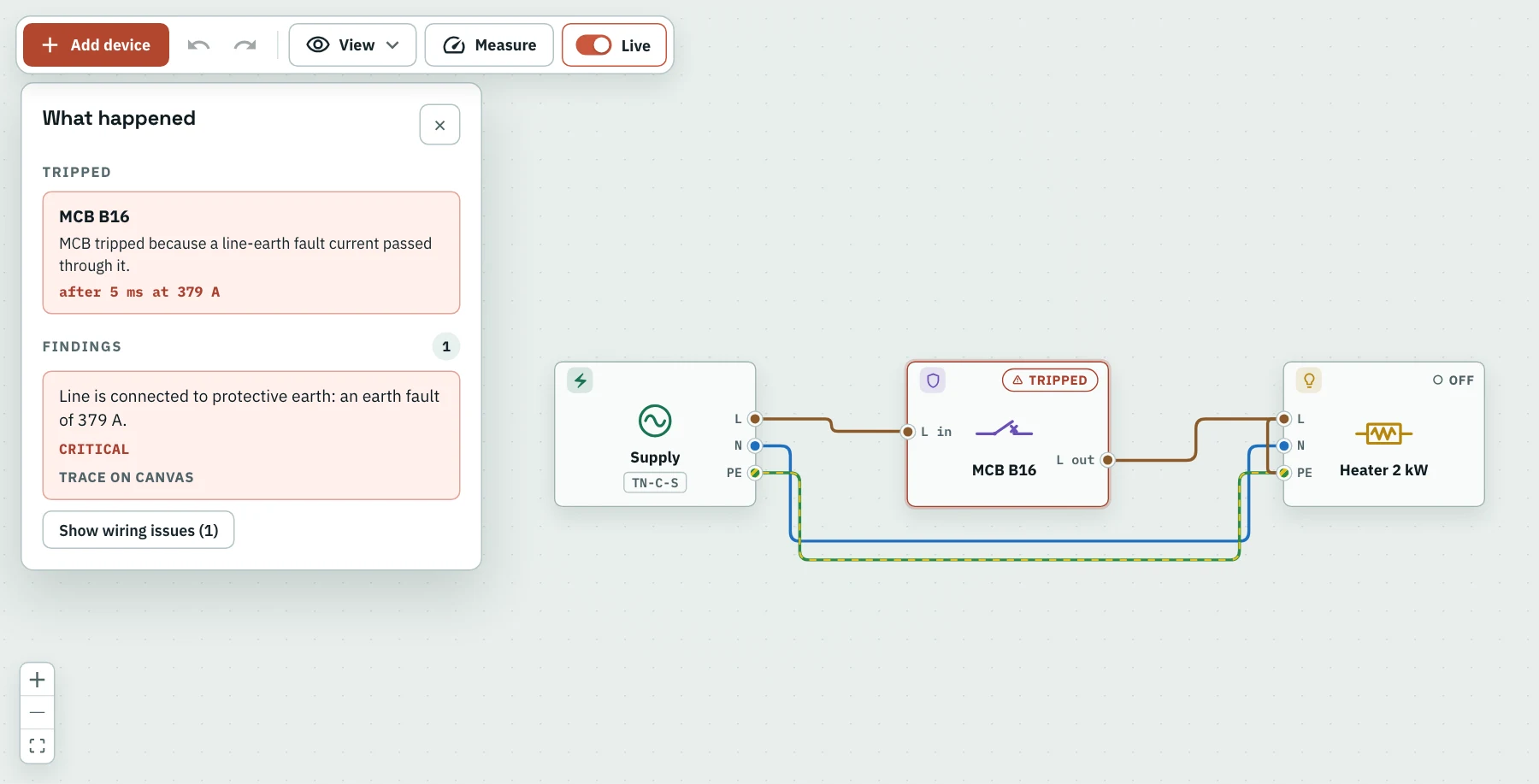
TN-C-S: the line touches a heater's metal case. The fault current returns through PE and the PEN, hundreds of amperes, and the B16 trips at once.
TN-C: the old way
In TN-C, N and PE are combined all the way to the appliance. It is found in old buildings, where a two-core cable feeds a socket and the earth contact is bridged to the neutral. In Poland this was called zerowanie. It is not allowed for new final circuits: a PEN conductor must be at least 10 mm² copper, and an RCD cannot work on it, because the fault current returns through the same PEN that passes through the RCD.
TT: a local earth electrode
In TT, the installation has its own earth electrode (a rod or tape in the ground), with resistance RA. The supplier's neutral is earthed at the transformer (resistance RB). There is no metallic path between them: an earth fault current returns through the soil.
The soil is a poor conductor. With the typical values WireWhy uses by default, RA = 100 Ω and RB = 10 Ω:
- fault current ≈ 230 V ÷ (100 Ω + 10 Ω) ≈ 2.1 A;
- voltage on the faulty appliance's casing ≈ 2.1 A × 100 Ω ≈ 209 V.
A 16 A breaker will never trip on 2.1 A. The casing stays at about 209 V indefinitely. That is why a TT installation depends on RCDs: a 30 mA RCD sees 2.1 A of residual current and opens in milliseconds. IEC 60364-4-41 sets the condition RA × IΔn ≤ 50 V, so the earth electrode and the RCD must be chosen together.
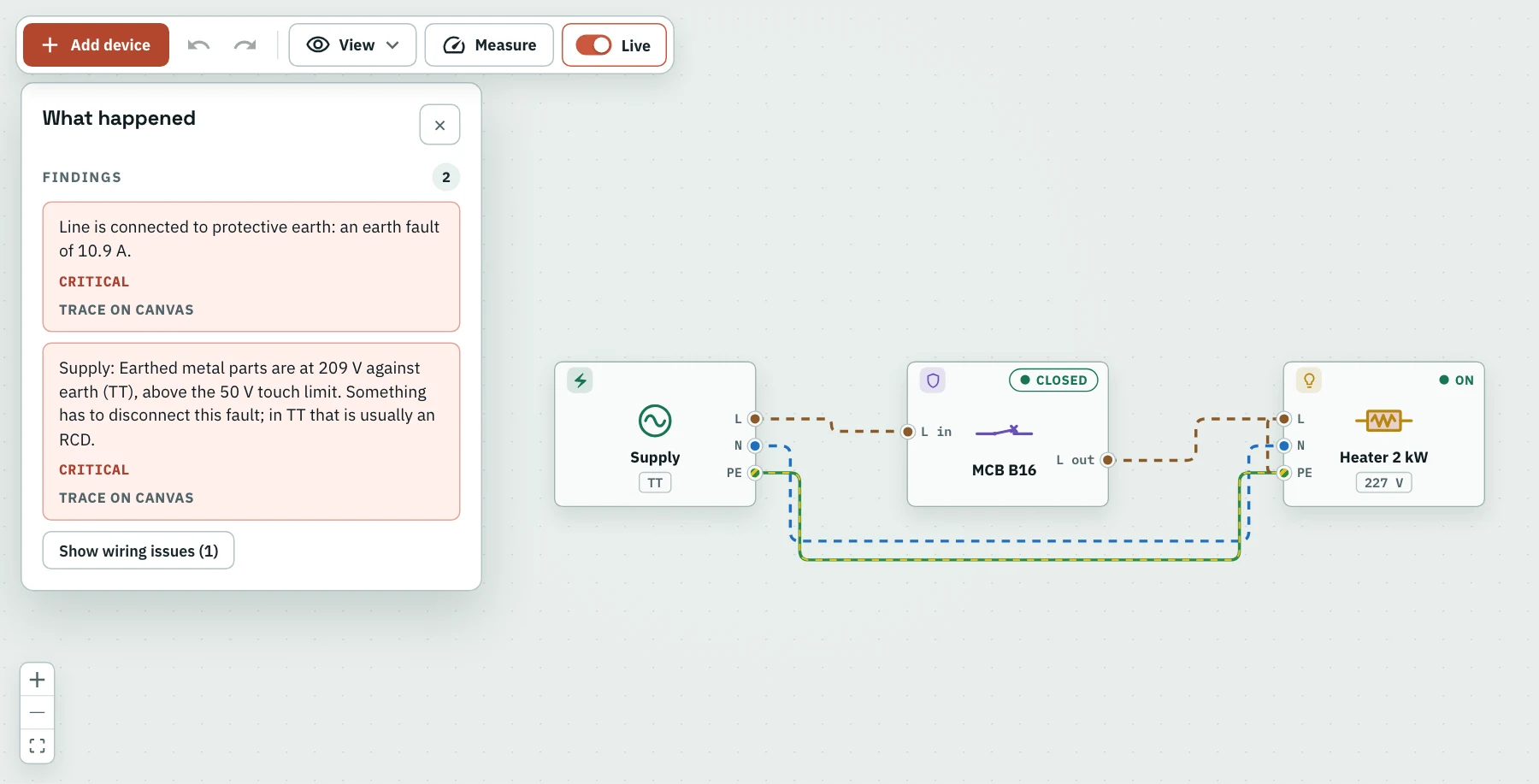
TT: the same fault. The current has to pass through the soil, too little to trip the B16, and the case stays at a dangerous voltage. In TT, an RCD is what disconnects this fault.
Side by side
| TN-S | TN-C-S | TT | |
|---|---|---|---|
| Protective earth from | Supplier, separate conductor | Supplier, split from PEN at the origin | Own earth electrode |
| Earth fault current | Large | Large | Small (a few amperes) |
| What disconnects | MCB or fuse (RCD for extra protection) | MCB or fuse (RCD for extra protection) | RCD |
| Main risk | A lost or corroded earth sheath; long cables raising Zs | Broken PEN | Electrode resistance; a missing or faulty RCD |
| Final circuits up to 32 A must disconnect within | 0.4 s | 0.4 s | 0.2 s |
(IT systems, where the source is isolated from earth, keep running after a first fault and are used in hospitals' operating theatres and some industry. They are outside the scope of this article.)
What is used where
- UK: most supplies are TN-C-S (PME); older urban ones are TN-S; many rural ones on overhead lines are TT.
- Germany: TN-C-S is the norm; TT is found in some network areas, mostly rural.
- Poland: new installations are TN-C-S; many older blocks still have TN-C wiring, and some distribution companies supply TT in rural areas.
- Brazil: NBR 5410 recognises TN-S, TN-C-S, TN-C, TT, and IT. Which one applies depends on the distribution company and on the installation's entrance; homes are commonly TN-C-S or TT.
Which system your installation has is decided by the supplier and the designer, and is recorded on the installation's documentation. If you are unsure, an electrician can tell you, and measure whether the earthing is good.
Try the three systems on one circuit
In WireWhy, the earthing system is a setting on the supply: TN-C-S (the default), TN-S, or TT, with Ze, RA, and RB editable. Build a socket circuit with an MCB, put an earth fault on the socket, and switch between systems: in TN-C-S the breaker trips instantly; in TT it does not, and WireWhy reports the touch voltage on the exposed metal. Add a 30 mA RCD and it trips again. Then turn on the supply's broken PEN setting and see what happens to the lamps and the PE.
Open the canvas at wirewhy.com/app. The breaker side of this story is in MCB trip curves B, C and D explained, and the RCD side in Why does my RCD trip?