MCB trip curves B, C and D explained: why a breaker trips, and why it sometimes does not
A circuit breaker has two ways of tripping: slowly on overload and instantly on a short circuit. The letter before the rating says where one ends and the other starts. What B16 and C16 really mean, and how to choose.
Also in: Polski · Português (Brasil) · Deutsch
Every miniature circuit breaker (MCB) carries a code like B16 or C10. The number is the rated current in amperes. The letter is the trip curve, and it answers a question most people never ask: how large does a current have to be before the breaker opens instantly?
Two releases, one contact
An MCB has two separate mechanisms acting on the same contact.
- The thermal release is a bimetal strip that the current warms up. It bends slowly and trips the breaker on an overload: a little too much current for a long time. The larger the overload, the sooner it trips.
- The magnetic release is a coil. When the current jumps to many times the rating, as in a short circuit, the coil pulls the latch open within a few milliseconds.
The thermal release protects the cable from slowly overheating. The magnetic release deals with fault currents that would damage it within seconds.
What the rating promises
For breakers to IEC 60898-1 (the standard for household MCBs), the thermal side is defined by three points. With In the rated current:
| Current | What the breaker must do |
|---|---|
| 1.13 × In | Not trip for at least an hour |
| 1.45 × In | Trip within an hour |
| 2.55 × In | Trip within 1 to 60 s (up to 120 s above 32 A) |
So a B16 must hold 18 A for at least an hour, and must trip at 23 A within an hour. That is slow on purpose: a kettle and a heater on the same circuit for five minutes will not trip it, and should not.
The 1.45 figure is not an accident. IEC 60364-4-43 asks that the current that surely trips the device is no more than 1.45 times what the cable can carry continuously (Iz). For an MCB this reduces to a simple rule, Ib ≤ In ≤ Iz: the load current is at most the breaker's rating, and the breaker's rating is at most the cable's.
The curves: where "instant" starts
The letter says in which band the magnetic release is guaranteed to act:
| Curve | Instant trip between | For a 16 A breaker | Typical use |
|---|---|---|---|
| B | 3 and 5 × In | 48 to 80 A | Homes, sockets, lighting, long cables |
| C | 5 and 10 × In | 80 to 160 A | Motors, fluorescent and LED groups, inrush currents |
| D | 10 and 20 × In | 160 to 320 A | Transformers, welding equipment, large motors |
Below the band, the breaker relies on the thermal release and may take seconds or minutes. Above it, it opens in well under a tenth of a second, typically a few milliseconds. Inside the band, it depends on the individual breaker.
Why the curve matters: inrush and fault current
Many loads draw a surge when switched on: a motor starting, a transformer magnetising, a large group of LED drivers charging their capacitors. A B breaker may see that surge as a short circuit and trip every time the load starts. That is the main reason to choose C.
But a higher curve has a price. To trip instantly, the breaker needs a larger fault current, and the fault current is limited by the impedance of the whole loop: the supply, the cable to the fault, and back. That is the earth fault loop impedance, Zs. Under IEC 60364-4-41, a final circuit up to 32 A at 230 V must disconnect an earth fault within 0.4 s in a TN system. The simplest way to guarantee that is the magnetic release, so Zs must be small enough for the fault current to reach the top of the band:
| Breaker | Current for a sure instant trip | Largest Zs (230 V ÷ that current) |
|---|---|---|
| B16 | 80 A | about 2.9 Ω |
| C16 | 160 A | about 1.4 Ω |
| B10 | 50 A | about 4.6 Ω |
| C10 | 100 A | about 2.3 Ω |
National tables are a little stricter, because they allow for a lower supply voltage and warm conductors; BS 7671, for example, lists 2.73 Ω for a B16. The idea is the same: a long, thin cable on a C breaker may never trip instantly on an earth fault. That is why B is the default in homes, and C is chosen for a reason.
In a TT system the fault current is usually far too small for any MCB, and disconnection relies on the RCD. The next article in this series covers earthing systems.
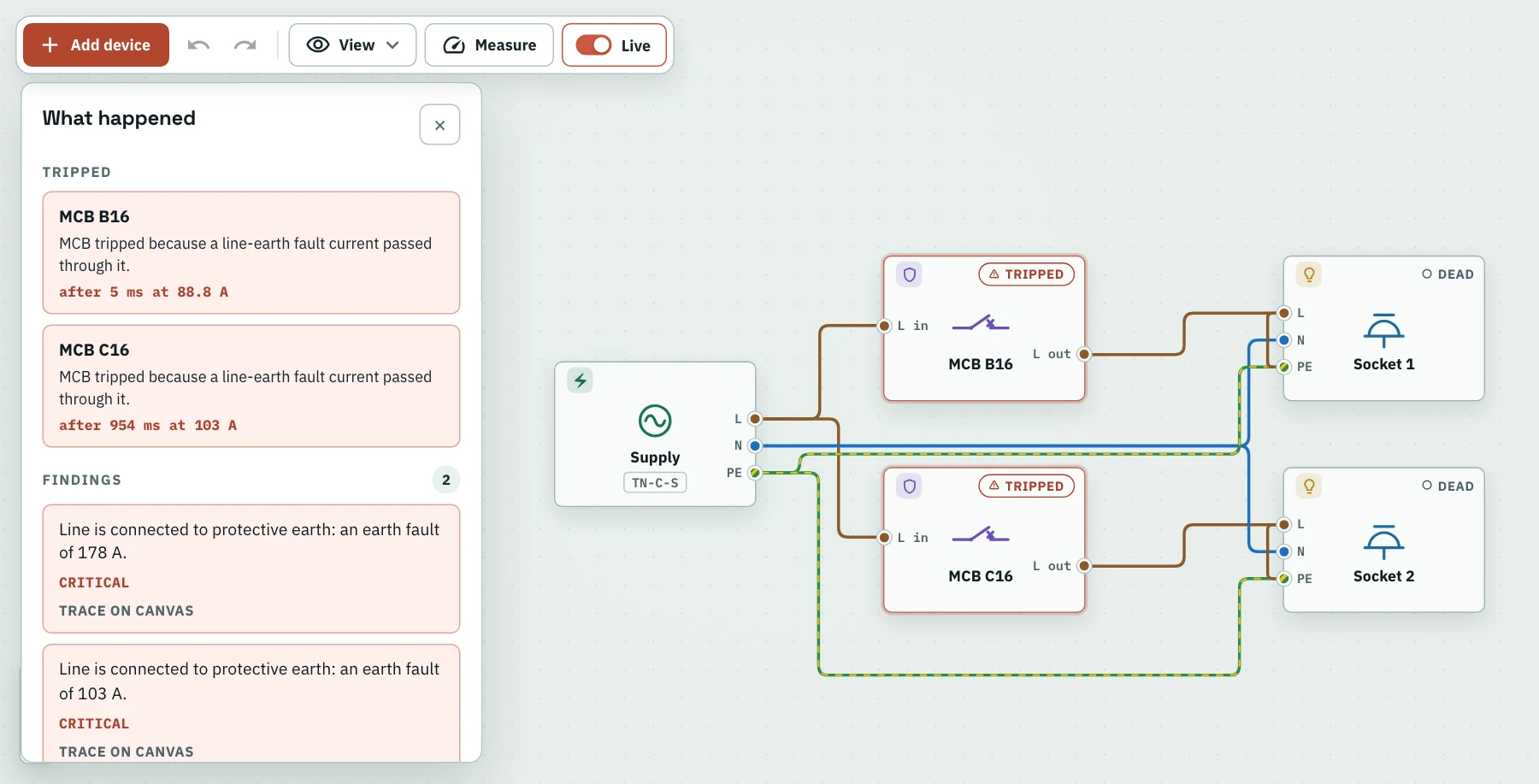
The same earth fault at the end of 80 m of 1.5 mm² cable, around 90 to 100 A. That is past a B16's instantaneous threshold, so it trips in milliseconds; a C16 needs more, so it waits for its thermal release, almost a second.
Why a breaker trips
- Overload: too many appliances on one circuit. It trips after seconds to minutes, and the breaker may feel warm.
- Short circuit: line touching neutral, or line touching a metal part connected to earth. It trips instantly, often with a bang.
- Inrush: it trips only at the moment something is switched on, typically a motor or a large lighting group on a B curve.
- A faulty appliance: it trips every time one particular appliance is plugged in or switched on.
Why a breaker does not trip when it should
This is the more dangerous case:
- The breaker is larger than the cable. A 20 A breaker on 1.5 mm² cable can let the cable carry more than it should for hours. The cable heats up, its insulation ages, and eventually it fails. The breaker protects the cable only if it is rated for it.
- The loop impedance is too high for the curve, as above. An earth fault then leaves the metal casing live for seconds instead of milliseconds.
- The breaker is in the neutral instead of the line. It switches the circuit off, but everything behind it stays live.
What cross-section a rating needs depends on how the cable is installed and on national rules. In Poland and the UK, 16 A socket circuits usually run in 2.5 mm²; in Germany, 1.5 mm² with a B16 is common for installation methods that allow it; in Brazil, NBR 5410 sets 2.5 mm² as the minimum for socket circuits. Choosing and checking this is the job of the person designing the installation, and it is exactly what the inspection after installation verifies.
National notes
- UK: Types B, C, and D to BS EN 60898; ring final circuits use a 32 A breaker on 2.5 mm².
- Germany: the Leitungsschutzschalter (LS-Schalter); Auslösecharakteristik B is standard in homes.
- Poland: wyłącznik nadprądowy, commonly called eska after an old product line; B10 for lighting and B16 for sockets is the usual pair.
- Brazil: DIN-rail disjuntores follow NBR NM 60898, with the same curves.
Try it on the canvas
In WireWhy every MCB has a curve setting, B, C, or D, and the simulation uses the IEC 60898-1 bands (it takes each band at its middle, so a real breaker may trip anywhere within it). Put a heater on a B16 and add a second one to see the overload trip after its delay; put an earth fault at the end of a long cable and compare a B16 with a C16; put a 32 A breaker on 1.5 mm² cable with a heavy load and watch the cable overheat while the breaker holds.
Open the canvas at wirewhy.com/app and see which breaker trips, and when. For the device that protects people rather than cables, read Why does my RCD trip?