Real currents
Every wire, contact, and load is solved as a circuit. Faults that only currents reveal are caught: a borrowed neutral, a lost PEN, a neutral touching earth.
Electrical wiring simulator
Build a circuit, switch it, break it. Wirewhy solves the real currents, so you see exactly why the RCD trips, the breaker holds, or the lamp stays dark.
Continue your circuit →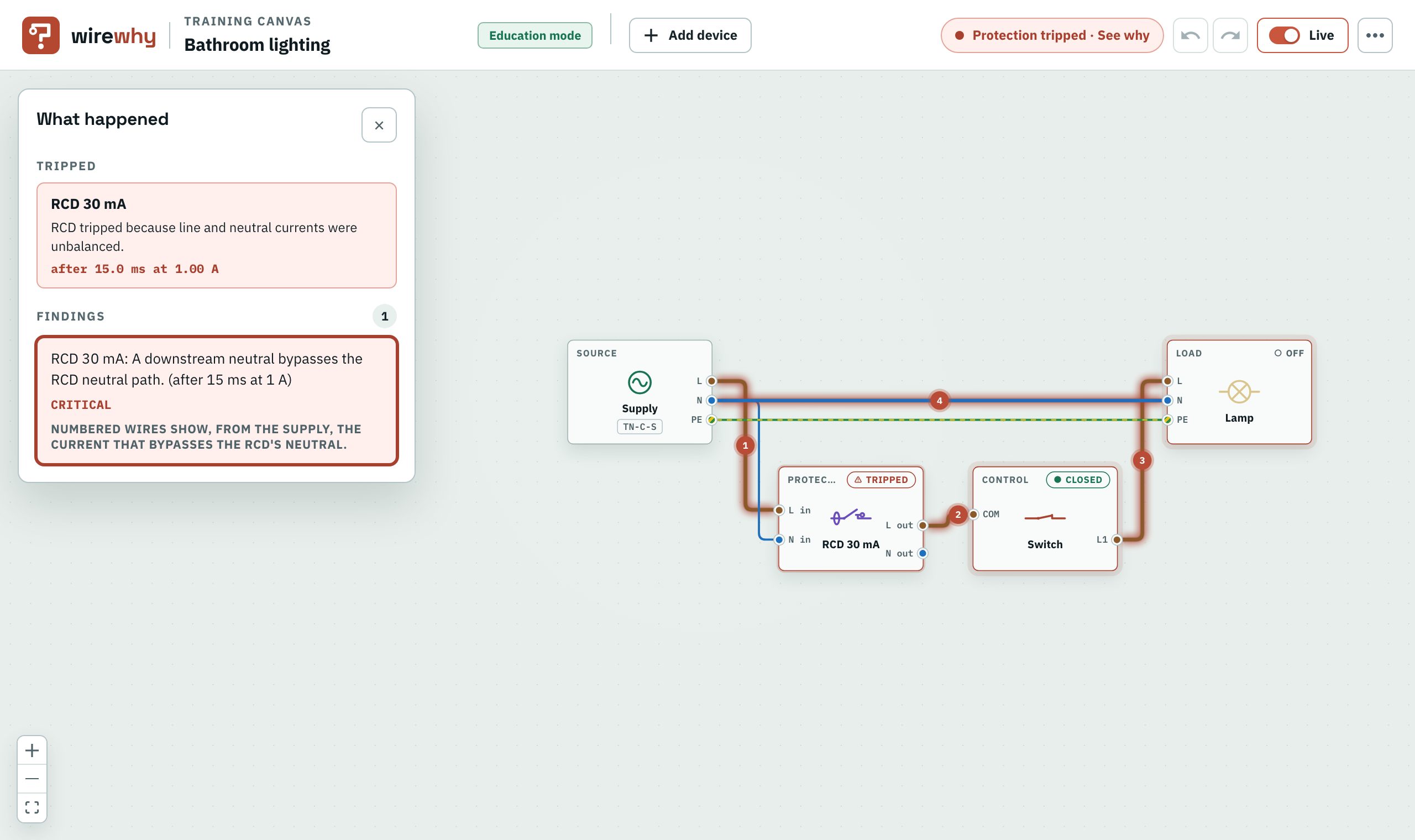
A lamp, an RCD trip traced wire by wire, a motor started and stopped by a contactor, a staircase timer, and an exercise from both sides: built by a teacher, solved by a learner.
Every wire, contact, and load is solved as a circuit. Faults that only currents reveal are caught: a borrowed neutral, a lost PEN, a neutral touching earth.
A short circuit, an earth fault, or current bypassing an RCD is numbered on the canvas from the supply, so the cause is never a guess.
Breakers with curves B, C, and D, RCDs from 10 to 500 mA, fuses, and selectivity: devices trip when and why the real ones would.
What you can do in Wirewhy today, in the browser, for free.
Currents and voltages on every wire, voltage drop at every load, prospective fault currents.
Short circuits, earth faults, and leakage past an RCD, numbered wire by wire from the supply.
MCBs with curves B, C, D; RCDs and RCBOs from 10 to 500 mA; fuses, the service fuse, and selectivity.
TN-C-S, TN-S, and TT; a broken PEN; touch voltage on exposed metal.
Push-buttons, contactors that hold themselves in, impulse relays, and staircase timers.
Every wire drawn and every switch flipped is simulated at once, with the reading on each wire.
What happened and why, for learners; rule identifiers and values for professionals.
Wire the answer, pick the checks, lock what learners may not change, and publish a link.
Share a broken circuit as a puzzle: the fault stays hidden until it is found.
A class joins with a short code and watches the teacher's canvas and simulation live.
A short link to any circuit, and a PNG picture for worksheets and posts.
English, Polish, and Portuguese; computers, tablets, and phones; light and dark.
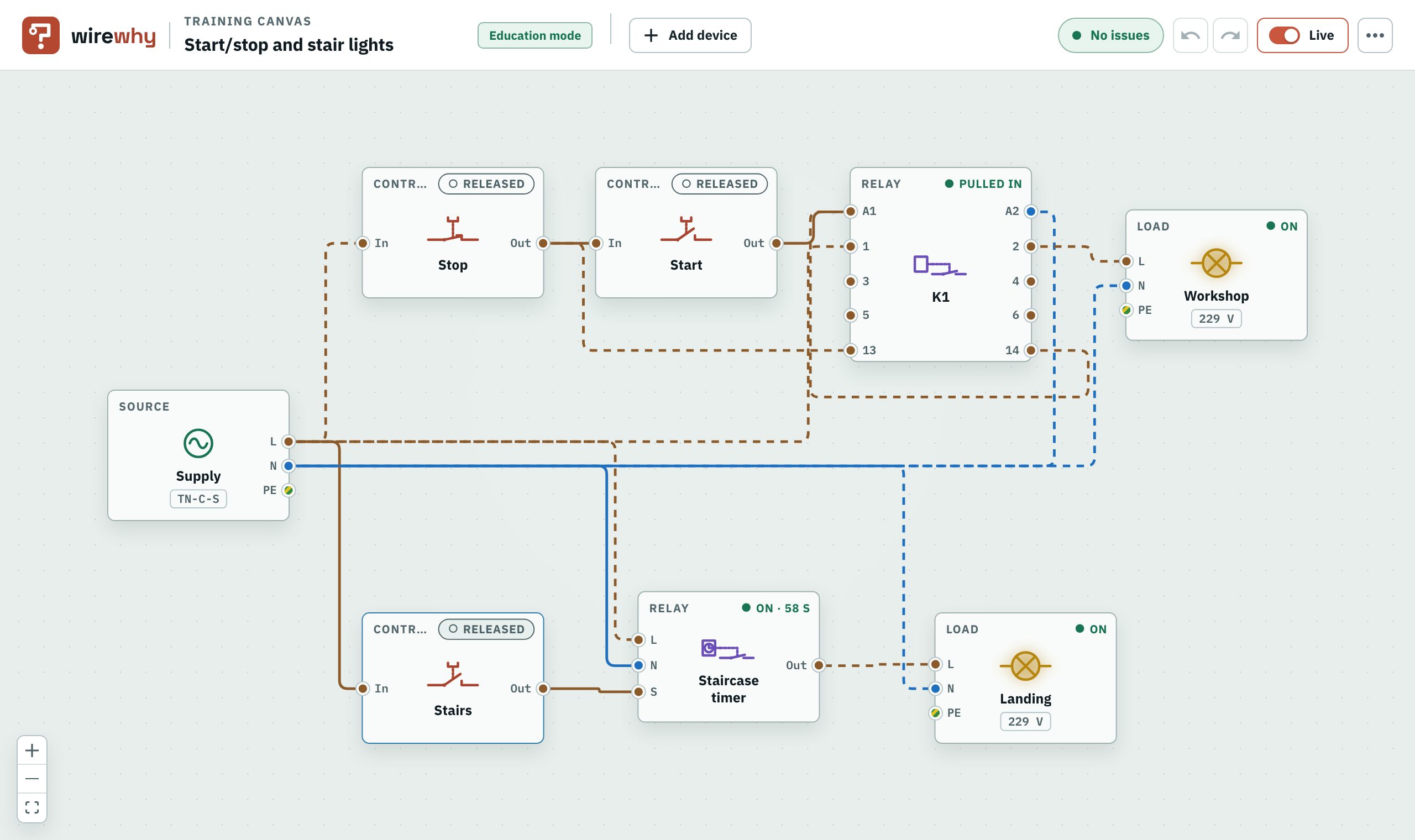
Start and stop buttons with a contactor that holds itself in, impulse relays, and staircase timers that count down on the canvas. Supplies in TN-C-S, TN-S, and TT; one-way, two-way, and intermediate switches; sockets, heaters, and motors.
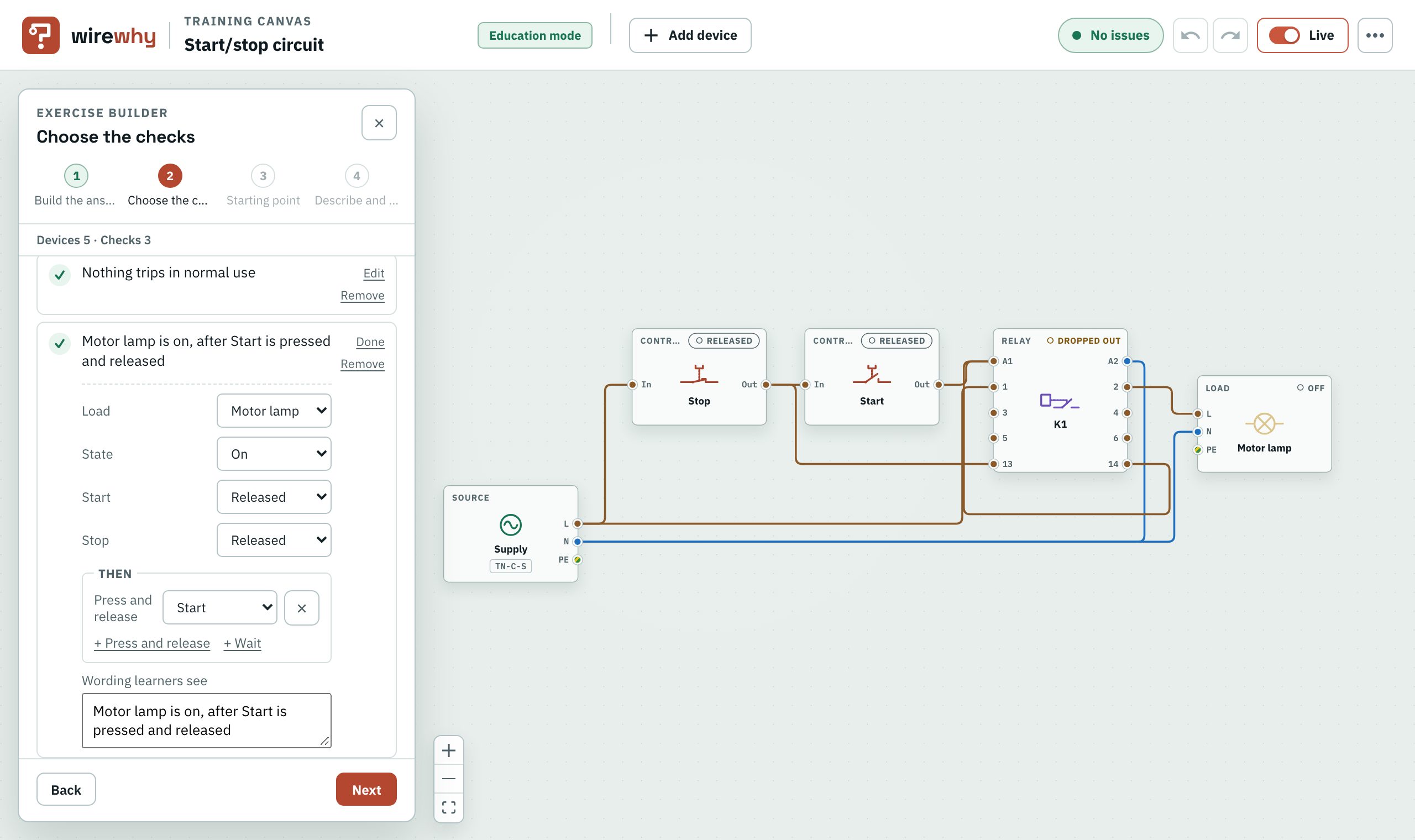
Wire the answer, pick the checks ("the lamp is on when Switch is closed", "only the RCD trips"), choose the starting point, and publish. Learners get instant, fair feedback; any wiring that passes every check counts.
Practise with exercises that check your wiring, and find-the-fault puzzles. Mistakes cost nothing here.
Build an exercise with checks in minutes, share it as a link, and let a whole class follow your canvas live.
Check an idea before it goes into a wall: what trips, what stays live, and what a customer's odd wiring really does.
Yes. The canvas, the simulation, exercises, sharing, and picture export are free to use.
No. Open the canvas and start. Your circuit is kept in your browser until you share it.
Generic training assumptions based on IEC 60364: earthing systems, protective devices, and touch voltage. Country rulesets (such as PN-HD 60364 and NBR 5410) are planned.
Yes. Devices, wires, and the simulation work by touch; a larger screen is more comfortable for big circuits.
Yes. Share an exercise or a puzzle as a link, or start a follow-along session: the class joins with a short code and sees your canvas live.
No. Wirewhy is a training tool for understanding circuits and faults, not a design or certification tool. Work on real installations needs a qualified electrician.
Your circuits stay in your browser until you share them.
Open the canvas